Who will you share a cup with?
This blend—which includes our expertly aged Sumatran beans — is specially roasted to bring out their depth and vibrance. The cedary-spice notes pair perfectly with holiday flavors including cinnamon, nutmeg and cloves.
Available in whole bean, ground, K-Cup® and Verismo® Pods, and Starbucks VIA® Instant Coffee.

The Best Coffee. Starbucks Coffee Finder.
Our coffee masters have distilled their years of tasting knowledge down to three simple questions to help you find a Starbucks coffee you’re sure to love.
OUR RAREST COFFEES, SMALL-BATCH ROASTED IN SEATTLE
We travel the world in search of great coffee. In the process, we discover beans so special and rare that we can’t wait to bring them home and share. Each of these small-lot coffees has its own story to tell, and we meticulously develop a signature roast for every one of them.

How to Brew
It’s surprising how different brewing methods can enhance particular characteristics in your coffee. Let us help you unlock the full potential of your coffee—for the perfect cup every time.
Career Center
For Business
Online Community
Quick Links
© 2017 Starbucks Corporation. All rights reserved.
DER WAHRE ESPRESSO
Eine dichte, haselnussbraune Crema mit leichten, dunkelbraunen Streifen. Ein reiches Aroma mit Noten von Schokolade, geröstetem Brot, Honig und Karamell. Ein vollmundiger Geschmack, weich und samtig. Und ein Hauch von Bitterkeit, der nach etwa zwei Minuten einsetzt. Das ist es, was illy Espresso so unvergleichlich macht.
Auch zu Hause reichen für einen perfekten Espresso eine gute Espressomaschine und einige Gramm der illy Kaffeemischung. Fertig gemahlen, perfekt für Espresso, in Dosen zu 250 oder 125 Gramm.
Luftdicht verpackt
Die Verpackung in luftdicht verschlossenen Dosen garantiert die Frische des illy Aromas. Nach dem Öffnen empfiehlt sich die Aufbewahrung im Kühlschrank.

VERWANDTE INHALTE
Erfahren Sie mehr über die Welt von illy

BELIEBTE SEITEN
Dies sind die beliebtesten Seiten unter den Facebook-Nutzern. Klicken Sie auf „Gefällt mir“ wenn Ihnen diese Seite gefällt.
Via Flavia 110, 34147 Trieste, Italy, Register of Companies of Trieste - registration number and VAT code IT00055180327, share capital € 50.000.000,00 fully paid
Milder Mahlkaffee
Präsident Mild is a well-balanced blend of naturally mild coffees, selected in the countries of origin with utmost care. It has a soft, sweet and delicate flavor and a mild aroma with hints of fresh fruits.
- Arabica
- Robusta
4 Medium to dark
6 Very Dark">
1 Fine (e.g. for Espresso)
2 Medium fine (e.g. for Moka Pot)
3 Medium coarse (e.g. for Filter)
4 Coarse (e.g. for French Press or Filter)">
Это видео недоступно.
Очередь просмотра
- Удалить все
- Отключить
Philips SENSEO® Latte Duo Kaffeepadmaschine HD7855/50-HD7856/50
Хотите сохраните это видео?
- Пожаловаться
Пожаловаться на видео?
Понравилось?
Не понравилось?
SENSEO® Kaffeevielfalt: sechs Rezepte
aufgeschäumte Milch zubereiten – und all das blitzschnell durch die Zubereitung von zwei Tassen.
• Nur SENSEO® Latte Duo bereitet 2 Getränke mit Milch auf einmal zu
• Genießen Sie 4 Kaffee- und Milchrezepte auf Knopfdruck
• Fester, heißer Milchschaum dank patentiertem Aufschäumsystem
• Auswahl der Kaffeestärke: kleiner, starker oder milder, normaler Kaffee
• Leckere Crema für Ihren Kaffee als Beweis für die SENSEO® Qualität
• Gerät wird mehr als 10.000 Mal geprüft, um gleichbleibende Qualität sicherzustellen
• Große Auswahl an Kaffeemischungen und Geschmacksrichtungen
• Leicht zu reinigendes Milchaufschäumsystem und Entkalkungsprogramm
• Schäumen Sie Milch direkt aus einer Milchtüte oder Kanne auf
• Anpassbare Schale für Ihre Lieblingstasse
• Intuitive Bedienelemente für eine intelligente Benutzerführung
Die richtige Ernährung gegen Blähungen
Blähungen können durch die Ernährung ausgelöst werden. Wir zeigen dir, welche Lebensmittel zu Blähungen führen und was du stattdessen essen kannst.
Blähungen sind nach wie vor ein Tabu-Thema, über das wenig gesprochen wird.
Für Blähungen kann es verschiedene Gründe geben. Die Ernährung ist eine häufige Ursache, aber es können auch tiefergehende medizinische Probleme vorliegen. Länger anhaltende Blähungen sollten daher auf jeden Fall medizinisch untersucht werden.
Gegen ernährungsbedingte Blähungen haben wir jedoch die passenden Tipps parat.
Diese Ernährungsgewohnheiten können Blähungen verursachen
Folgende Ernährungsgewohnheiten können Blähungen verursachen. Falls du unter Blähungen leidest, solltest du diese meiden bzw. verringern. Wenn hingegen alles in Ordnung ist, musst du an deiner Ernährung auch nichts verändern.
Gashaltige Lebensmittel
Blähungen sind ein Überschuss an Gasen im Verdauungstrakt. Manche dieser Gase entstehen während der Verdauung, andere werden aber mit den Lebensmitteln aufgenommen. Gashaltige Lebensmittel sind beispielsweise Getränke mit Kohlensäure (prickelndes Mineralwasser, verschiedene Softdrinks), aber beispielsweise auch Schlagobers.
Ballaststoffreiche Lebensmittel
Ballaststoffreiche Lebensmittel sind grundsätzlich gesund. In größeren Mengen können sie aber auch zu Blähungen führen. Dazu gehören insbesondere Hülsenfrüchte, verschiedene Gemüse, Vollkornprodukte bzw. Getreideprodukte.
Dabei kann die Reaktion je nach Person unterschiedlich sein - beispielsweise vertragen manche Menschen weniger Hülsenfrüchte (z.B. Bohnen) als andere.
Schnelles Essen
Schnelles Essen kann dazu führen, dass beim Schlucken auf viel Luft geschluckt wird. Besser: Langsam essen und mehrmals kauen.
Zu große Essensmengen
Große Essenmengen in kurzer Zeit können ebenfalls zu Blähungen führen. Insbesondere wenn es sich um fettige und schwer verdauliche Speisen handelt.
Falsche Ernährung am Abend
Spätes nächtliches Essen kann ebenfalls zu Blähungen am nächsten Tag führen. Das Abendessen sollte mehrere Stunden vor dem Schlafengehen eingenommen werden.
Wer erst am späten Abend isst, sollte nur kleine Mengen zu sich nehmen und leicht verdauliche Lebensmittel bevorzugen.
Nahrungsmittelunverträglichkeiten
Blähungen können auch auf Nahrungsmittelunverträglichkeiten hinweisen. Beispielsweise Unverträglichkeiten gegen Fructose, Lactose, Histamin oder Gluten.
Die richtige Ernährung bei Blähungen
Die oben genannten Ernährungsweisen sollten natürlich vermieden werden. Darüber hinaus gibt es einige Lebensmittel, die bei Blähungen gut verträglich sind:
Rohes Gemüse meiden
Vermeide rohes Gemüse - besser gut blanchierten oder dünsten.
Leicht verdauliche Lebensmittel
Bevorzuge leicht verdauliche Lebensmittel. Anbei eine kleine Gegenüberstellung mit leicht und schwer verdaulichen Lebensmitteln.
Langsam essen und gut kaufen
Die meisten Menschen kauen zu wenig. Kauen ist bereits der erste Schritt der Verdauung, bei dem du deinem Verdauungstrakt die Arbeit des Zerkleinerns erleichtern kannst. Beim Kauen wird außerdem viel Speichel freigesetzt. Speichel enthält wochtige Verdauungsenzyme.
Regelmäßig Wasser und Tee drinken
Ausreichend Flüssigkeit hilft auch bei der Verdauung. Wichtig: vermeide Alkohol, Kaffee und Zuckerersatz - denn auch diese können Blähungen fördern.
Light Roast vs. Dark Roast
Common Misconceptions, Our Roasting Philosophy, and the Great Strength Debate
Common Misconceptions
1) Light Roasted coffee has more/less caffeine than Dark Roasted coffee.
There are a couple of dueling misconceptions about light roasted coffee concerning the caffeine content. In our experience, those coffee drinkers weened on the specialty coffee of the 1970's and the famous oily black beans of the era, tend to believe that Dark Roasted coffee packs more punch. Indeed it may from a perspective of pure intensity, but that doesn't mean it carries more caffeine. Then there are those who have come of age in the Third Wave of coffee and are happy to report that in fact Light Roasted coffee has more caffeine since dark roasting burns out all the go-juice. The truth is, however, that the caffeine content in one coffee "bean" is the same no matter if it is Light or Dark roasted. The difference in caffeine content comes from the volume of coffee used when brewing. Light Roasted beans are SMALLER than their Dark Roasted counterparts because their cellular fibers haven't been blown apart and expanded. So if you measure your coffee using a scoop, then yes, you're getting more caffeine when you used a Light Roast because more beans can fit in that scoop. However, if you weigh your coffee (like most coffee pros) the caffeine content should be the same.
2) Light Roasted coffee is milder than Dark Roasted coffee.
Allow us to make a beer analogy. While it would be reasonable, though inexact, to say that Miller is milder than Dogfish Head, comparing the two is like comparing apples and agent orange. This is how we feel about comparing conventional medium roasted coffee like you might find on the grocery store shelf to ANY specialty coffee. A more proper comparisan might be Rogue Mocha Porter vs Dogfish Head 90 Minute IPA. Which one is stronger or milder? Who cares? Strength is not the issue as much as character, complexity, uniqueness, and personal preference. A Lighter roasted coffee has deep complexity, intense sweetness, fruit tanginess, high floral aroma and is representative of the country of origin and the talent of the roaster to bring out those unique elements. A Darker roasted coffee is mainly representative of a particular roast profile reflecting the roaster's ability to create sweetness and richness out of what will inevitably be a less complex character.
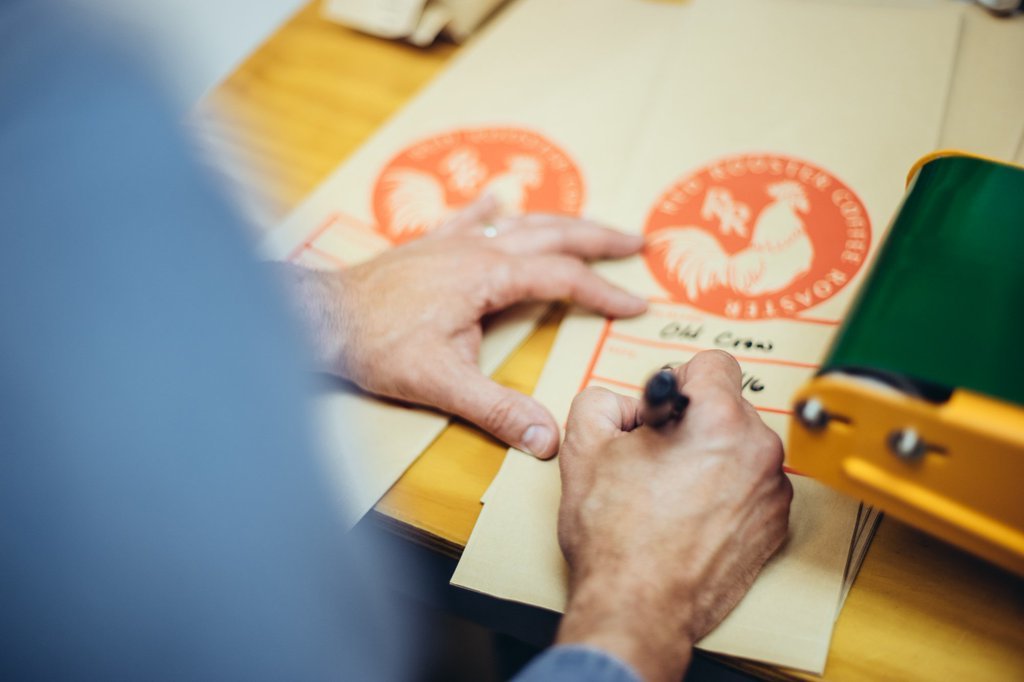 We roast to order, so each wholesale bag gets a name and a date.
Our Roasting Philosophy
We think a lot about coffee. The thing we care most about is doing justice to the great organic specialty green coffee that comes in our doors every week. We buy some of the best green coffee in the world and our mission is to roast that coffee to its fullest potential. To that end, we mostly roast to a light or medium profile in an attempt to bring out the richness and complexity of a particular origin; blueberries in our Ethiopian Harrar, orange zest in our Guatemalan Huehuetenango, lemony brightness in our Colombian Valle de Cauca. While we appreciate that many people prefer darker roasts (see our 4&20 French Roast or our Sumatra Mandheling) our personal preferences guide most of our roast profiles. Our coffees are designed to be sweet, complex, fruity and delicious to drink black at any temperature.
The Great Strength Debate
We often get asked for our strongest coffee. The truth is, this is a misleading question. In our experience, it often seems to refer to darkness of roast and intensity of flavor. However, when we think of the word strength, we tend to think of brew ratios: X amount of coffee to X amount of water. We find this to be a less subjective way to think about strength since it can be accurately measured. While intensity of flavor is a purely subjective choice (strong burned flavor or strong blueberry flavor?) 25 grams of coffee for 12 ounces of water is a true and accurate measure of brewing strength.
Gemahlener Kaffee
Gemahlener Bohnenkaffee in vielen unterschiedlichen Röstungen von Jacobs Krönung, Melitta, Dallmayr und weiteren tollen Marken. Ideal für die Kaffeemaschine oder fürs Aufbrühen im Handfilter.

Lieferzeit 1-2 Werktage mehr.

Lieferzeit 1-2 Werktage mehr.

Lieferzeit 1-2 Werktage mehr.

Lieferzeit 1-2 Werktage mehr.

Lieferzeit 1-2 Werktage mehr.

Lieferzeit 1-2 Werktage mehr.

Lieferzeit 1-2 Werktage mehr.

Lieferzeit 1-2 Werktage mehr.

Lieferzeit 1-2 Werktage mehr.

Lieferzeit 1-2 Werktage mehr.

Lieferzeit 1-2 Werktage mehr.

Lieferzeit 1-2 Werktage mehr.

Lieferzeit 1-2 Werktage mehr.

Lieferzeit 1-2 Werktage mehr.

Lieferzeit 1-2 Werktage mehr.

Lieferzeit 1-2 Werktage mehr.

Lieferzeit 1-2 Werktage mehr.

Lieferzeit 1-2 Werktage mehr.

Lieferzeit 1-2 Werktage mehr.
Lieferzeit 1-2 Werktage mehr.

Lieferzeit 1-2 Werktage mehr.

Lieferzeit 1-2 Werktage mehr.

Lieferzeit 1-2 Werktage mehr.

Lieferzeit 1-2 Werktage mehr.

Lieferzeit 1-2 Werktage mehr.

Lieferzeit 1-2 Werktage mehr.

Lieferzeit 1-2 Werktage mehr.
Alternativen zu Ihrer Auswahl:
Ergänzungen zu Ihrer Auswahl
Filterkaffee & gemahlener Kaffee
Viele Menschen kommen morgens ohne einen ordentlichen Kaffee einfach nicht in Schwung. Aber auch zwischendurch sorgt das belebende Getränk für wahren Genuss und vertreibt Müdigkeit. Der schwarze Muntermacher ist schließlich nicht umsonst das drittliebste Getränk der Deutschen. Auf dem weiten Weg von Afrika über Arabien hat die Kaffeebohne viele Herzen erobert und verspricht ausgezeichneten Genuss. In unserem Kaffee Angebot dreht sich daher alles um die köstliche Bohne. Hier können Sie nicht nur Filterkaffee, Espresso und frische Kaffeebohnen kaufen, sondern auch die passenden Verfeinerungen wie Milch & Sahne.
Neben Lebensmitteln und Drogeriebedarf ist bitiba vor allem der Spezialist für Tierfutter & Tierzubehör mit einem riesigen Sortiment und Discountpreisen.
Preise inkl. MwSt. UVP = unverbindliche Preisempfehlung
International:
Soweit verfügbar, erfolgt die Lieferung innerhalb der genannten Anzahl von Werktagen.
Who kicks ass
Wake up in the mountains


Our Smart Ass ® coffee, of course.
We think good stories, like good coffee, are best shared.
Made in the mountains for more than two decades.

Get clicking. Start looking and go shopping.
Coffee Addict
2012年6月25日 星期一
Dieseldorff KAFFEE

Processing Type: Roasted
Grade: SHB - STRICTLY HARD BEAN
Packaging: 400g Bag
Brand Name: DIESELDORFF
Farms(fincas): Finca Santa Margarita, founded by the Deiseldorff family
Cultivation Type: Other
Drip coffee Maker:
Adjust strength to taste by adding hot water after preparation has been completed.
A coffee so smooth you will want to drink it black.
Today you can experience the smooth taste of this finely crafted coffee. Unlike many other roasters, we put a short sell by date on the package to ensure an uncompromised taste.
Milder kaffee


Coffee Chemistry: Coffee Acidity
The perceived acidity of coffee results from the proton donation of acids to receptors on the human tongue. Coffee acidity is typically a highly valued quality especially in Central American and some East African coffee. Sourness, however, is an extreme of acidity and can be considered a coffee defect. Acidity has been correlated with coffees grown at very high altitudes and in mineral rich volcanic soils. The perceived acidity of washed coffees is also significantly higher than the acidity found in naturally (dry) processed coffee. This is likely due to an increase in the body of naturally processed coffees relative to wet processed coffees since body masks the acidity in coffee. The coffee acid content in a brew is also greatly dependent upon the coffee roasting degree, type of roaster, and coffee brewing method.
The pH of a coffee has been found to correlate with the perceived acidity in coffee by Pangborn, Sivetz and Desrosier, and Griffin and Blauch; whereas Voilley et al. suggests that titratable acidity produces a better correlation to perceived coffee acidity.
The acids found in roasted coffee may be classified into three groups: aliphatic, chlorogenic, and alicyclic carboxylic and phenolic acids (Clarke, 25). Table 1 shows the main acids that have been reported in coffee.
pKa = 2.12 / 7.21 / 12.67, 65-108 µmole/100 mL.1 0.54% of dry matter. 2
a. Volatile Aliphatic Carboxylic
b. Non-Volatile Aliphatic Carboxylic
c. Heterocyclic furanoid carboxylic
1. Clifford, M. Tea and Coffee Trade J. 159: 8. 1987. 35-39.
2. Illy, A. and Viani, R. Espresso Coffee: The Chemistry of Quality. 107-110.
3. Clarke, R.J. The Flavour of Coffee. In Dev. Food Science. 3B: 1-47. 1986. 1-47.
In regards to the concentration of citric, malic, lactic, pyruvic and acetic acid, Blank found that a typical medium roast coffee consisted of 0.30%, 0.22%, 0.13%, 0.07%, and 0.27% of each acid, respectively (Clarke, 25). At very light roasts, Blank found that the total concentration of these acids was around 1.58%, while at dark roasts these acids could drop down to 0.71%.
Chlorogenic acids have been found to make up around 7% of the dry basis weight of Arabica coffee. The 3-CQA isomer-the largest isomer present-is found at 4-5%. Clifford and Jarvis found over 17 chlorogenic acid-like substances in 42 robusta samples. The chlorogenic acids are largely degraded during the roasting process mainly into quinic acid. Excessive quinic acid has been associated with unfavorable sourness when coffees are roasted too dark or brewed coffee is left on a heater plate. This sourness, however, is contradictory to the rise in pH and reduced perceived acidity at darker roasts and is likely operating under a different mechanism.
In a study by the Technical Unit of the International Coffee Organization, they reported on the acid concentration in coffee at different particle sizes, water temperature, and extraction times. The results have been detailed in Table 2, 3, and 4, respectively.
Table 2. Acid concentrations at different grind sizes. All brewing was carried out at 94°C for 5 minutes. (Source: ICO Sensory).
Course Grind Size (mg/L)
Extra Fine Grind (mg/L)
Table 3. Concentration of extracted acids at different brewing temperatures. All coffees were brewed using a fine grind for 5 minutes. (Source: ICO Sensory).
Table 4. Concentration of extracted acids at different brewing times. All coffees brewed were of a fine grind and were brewed at 94°C. (Source: ICO Sensory).
Virtually no free amino acids are still present after roasting for 5 min at 220°C (Maier, 568). However, the amino acids are important during the Maillard reaction in the production of aromatics early in the roasting process.
Phosphoric acid has been implicated as a major contributor to perceived acidity by Maier and Rivera, but an alternate conclusion has been reached by Griffin and Blauch who suggest that phosphoric acid might contribute, but is not directly correlated to the perceived acidity. The phosphate concentrations found in the latter study are nearly identical to those found for phosphoric acid in the Technical Unit Quality Series No 9 by the ICO.
It is still unknown which acids are imperative to recreate the acidity experienced in coffee. It is generally understood that citric acid, malic acid, and acetic acid are the most important because they exist in high proportions and have low pKa's. However, due to highly complex buffering effects and the wide distributions of salts and acids present in coffee, it is difficult to predict the exact mechanism and agents responsible for the perceived acidity in coffee.
Pangborn, R. M. Lebens. Wiss. And Technol. 1982. 15: 161-168.
Sivetz, M. and Desrosier, N. W. Coffee Technology. Avi Pub. Westport, Conn. 1979.
Griffin, M. J. and Blauch, D. N. ASIC 18th Colloq. Helsinki. 1999. 118-126.
Voilley, A.; Sauvageot, F.; Simatos, D.; and Wojcik, G. 1981. J. Food Processes. Preservation. 5: 135-143.
Maier, H. G. Proc 12th ASIC Colloq. 1987, 229-237.
Rivera, J. Organic Acid Analysis of Kenya SL 28 and Other Cultivars. SCI Technical Papers, 1997, 5-9.
Sensory Evaluation of Coffee: Technical Unit Quality Series. No 9. International Coffee Organization. 1991. 209-243.


Комментариев нет:
Отправить комментарий