Kaffee mcdonald's


Behind the Cup
McDonald's and Coffee Sustainability
At McDonald's, we're committed to bringing you great-tasting coffee and espresso brewed from high quality coffee beans. At the same time, we realize that when it comes to coffee sourcing — where we get our beans and the farmers who grow them — it's important that we think about the long-term impacts of coffee production and trading.
Globally, we're committed to sourcing coffee responsibly, and we're focusing our efforts in two primary ways.
Buying verified sustainable coffee. Globally in 2015, about 37% of our total coffee bean purchases were from Rainforest Alliance Certified™, Fair Trade USA or UTZ Certified farms. The majority of our certified coffee purchases are from Rainforest Alliance Certified™ farms, including 100% of our espresso in the U.S. and Canada, all McDonald’s coffee served in Brazil and all of our coffee in Australia and New Zealand. McDonald's markets in Europe source 100% of their coffee—with the exception of decaf—from farms that are Rainforest Alliance Certified, UTZ Certified or Fair Trade International.
Investing in farmer training: McDonald's USA, McDonald's Canada and their Franchisees invested more than $6 million over 4.5 years in farmer technical assistance. Learn more below.
We're supporting sustainable coffee—and farmers
While our goal to advance coffee sustainability is global, our efforts begin locally. McDonald’s has partnered with TechnoServe, an international non-profit and agricultural technical assistance provider, to train nearly 15,000 farmers in Guatemala in sustainable coffee-growing practices since launching the coffee technical assistance program in 2012. The initial results speak for themselves: participating farmers reported harvesting 48%* bigger yields than their neighbors despite difficult weather conditions and widespread Coffee Rust disease. Their crops are also earning a higher sustainability score.
We are also building industry-wide capacity by offering the farmer training curriculum developed by SCAN (Sustainable Commodities Assistance Network), a global network of 17 leading organizations promoting sustainable agriculture including UN agencies, certification programs and research institutions, for free on International Trade Centre's SustainabilityXchange website, as well as the SCAN's. Recognizing the long term impact of these programs, we will continue monitoring the impact of these trainings through the spring of 2017 and will update our reports accordingly.
* Initial results for participating farmers through 2015-16 harvest. We will continue to track performance over time and as we do this figure will vary.

Watch the Story


Meet the People
By working with TechnoServe, McDonald's is helping farmers in Guatemala develop sustainable farming practices.
Meet a few of the coffee farmers participating in the farmer training program with TechnoServe.


The Farmer
Meet Sandra Lopez, a Guatemalan coffee farmer carrying on the family tradition of coffee farming. As with many Guatemalan farming families, the Lopez's land and resources are limited, requiring great effort to generate profitable and sustainable coffee crops each year. Through our collaboration with international non-profit organizations, Sandra and farmers like her are provided with education, training and resources necessary to help improve their coffee production and farming practices, now and in the future.


McDonald's USA and McDonald's Canada source coffee from several Central and South American countries, including Guatemala and Colombia.
Despite its relatively small size, Guatemala boasts one of the most climatically diverse regions in the world and is well-known for quality coffee production.


The Trainer
Braulio is a native Guatemalan and Farmer Trainer for TechnoServe, where he educates Guatemalan coffee farmers on sustainable farming principles and practices.
As part of McDonald's investment in a farmer technical assistance program, TechnoServe, along with the Sustainable Commodity Assistance Network (SCAN), provide critical training for coffee farmers in Central America.
Through our collaborations with TechnoServe and SCAN, and with our investment in certified coffee purchases, (UTZ, Fair Trade and Rainforest Alliance), we're positioning farmers for expanded capacity of more sustainable coffee yields. All of this helps ensure our customers can continue to enjoy the consistent, flavorful coffee taste profile that they've grown to love and expect from McDonald's.
Reusing our Coffee Grounds
McDonald's also has aspirational goals to minimize waste and increase the amount of in-restaurant recycling to 50% by 2020. That includes coffee grounds and espresso beans, which contribute to greenhouse gas emissions when they begin decomposing in a landfill. Luckily, coffee grounds make great fertilizer for gardening!
To take advantage of this valuable waste stream, McDonald's USA implemented a used coffee grounds composting program called "Good Neighbor, Good Grounds" in 2015 to reduce the amount of organic waste being sent to landfills. Through the program, participating restaurants re-bag coffee grounds and give them to community members to use in their home gardens or donate them to community gardens. This not only helps the environment, it fosters community engagement and creates connections with the McDonald's brand.
Over 1,000 McDonald's restaurants in Oklahoma, Hawaii, California, Oregon, Washington and Arizona are now part of this program, including a new partnership between McDonald's, our franchisees and 150 statewide schools in the Arizona Department of Education School Garden Program! Watch Arizona media coverage on the program here. Recently, the US North West Region confirmed that 380 restaurants are onboard for coffee ground recycling with the community garden connection as of Spring 2016.
McDonald's Canada is planning to roll out the program in 2016. These efforts in North America build on the great momentum by many McDonald's markets in Europe to recycle or donate coffee grounds, food scraps and other kitchen waste streams. Read more about our restaurant sustainability efforts in the Planet pages.


Sustainability
Coffee production is just one area where McDonald’s is committed to sustainability. We’re taking bigger and bolder steps with our global network of Franchisees, suppliers and employees to lead meaningful change across our industry, our value chain and the communities we serve.
Discover the differences we're making for a more sustainable future.


©2010-2017 McDonald's. All Rights Reserved
From the 'Lectric Law Library's Stacks
The Actual Facts About - The Mcdonalds' Coffee Case
Most lawyers who win a case advise their clients, "We have won," and when justice has frowned upon their cause . "You have lost." -- Louis Nizer
Search The Library
SOME MAIN ROOMS
- Reference Room
- Free Legal Forms
- Legal Pro's Lounge
- 'Lectric Law Lexicon
- Lay People's Lounge
- Study of Law Study
- Business Law Lounge
- Periodical Reading Rm
- Inner Sanctum
- Rubber Room
- The Rotunda
- News Room
- Latin Etymology of Legal Terms
- Link Room
LEGAL TOPIC AREAS
- Alternative Dispute Resolution
- Antitrust & Unfair Trade
- Banking, Finance & Credit
- Bankruptcy
- Business Law, General
- Business Regulation
- Civil Legal System
- Constitutional Rights
- Consumer Protection
- Court Info & Rules, Fed
- Court Info & Rules, State
- Criminal Justice System
- Criminal Law & Procedure
- Drugs & Alcohol
- Employment & Labor
- Environmental Protection
- Family, Marriage, Kids
- Gov't Agencies, Federal
- Gov't Benefits & Entitlements
- Gov't Info Access
- Historic Court Decisions
- Historic Legal Documents
- Immigration
- Intellectual Property
- International Law
- Int'l Business & Finance
- Investments & Securities
- The Judicial System
- Laws/Statutes, Federal
- Litigation, General
- Medicine & the Law
- Real Estate, Landlord/Tenant
- Sex & the Law
- Taxation
MISC BUSHWAH
- Ralf's Amazing Library Tour
- The 'Lectric Looker-Upper
- Our Privacy Policy
- Contact Info
- Lectlaw Blog
PREMIUM ROOMS
- Premium Legal Forms
There is a lot of hype about the McDonalds' scalding coffee case. No one is in favor of frivolous cases of outlandish results; however, it is important to understand some points that were not reported in most of the stories about the case. McDonalds coffee was not only hot, it was scalding -- capable of almost instantaneous destruction of skin, flesh and muscle. Here's the whole story.
Stella Liebeck of Albuquerque, New Mexico, was in the passenger seat of her grandson's car when she was severely burned by McDonalds' coffee in February 1992. Liebeck, 79 at the time, ordered coffee that was served in a styrofoam cup at the drivethrough window of a local McDonalds.
After receiving the order, the grandson pulled his car forward and stopped momentarily so that Liebeck could add cream and sugar to her coffee. (Critics of civil justice, who have pounced on this case, often charge that Liebeck was driving the car or that the vehicle was in motion when she spilled the coffee; neither is true.) Liebeck placed the cup between her knees and attempted to remove the plastic lid from the cup. As she removed the lid, the entire contents of the cup spilled into her lap.
The sweatpants Liebeck was wearing absorbed the coffee and held it next to her skin. A vascular surgeon determined that Liebeck suffered full thickness burns (or third-degree burns) over 6 percent of her body, including her inner thighs, perineum, buttocks, and genital and groin areas. She was hospitalized for eight days, during which time she underwent skin grafting. Liebeck, who also underwent debridement treatments, sought to settle her claim for $20,000, but McDonalds refused.
During discovery, McDonalds produced documents showing more than 700 claims by people burned by its coffee between 1982 and 1992. Some claims involved third-degree burns substantially similar to Liebecks. This history documented McDonalds' knowledge about the extent and nature of this hazard.
McDonalds also said during discovery that, based on a consultants advice, it held its coffee at between 180 and 190 degrees fahrenheit to maintain optimum taste. He admitted that he had not evaluated the safety ramifications at this temperature. Other establishments sell coffee at substantially lower temperatures, and coffee served at home is generally 135 to 140 degrees.
Further, McDonalds' quality assurance manager testified that the company actively enforces a requirement that coffee be held in the pot at 185 degrees, plus or minus five degrees. He also testified that a burn hazard exists with any food substance served at 140 degrees or above, and that McDonalds coffee, at the temperature at which it was poured into styrofoam cups, was not fit for consumption because it would burn the mouth and throat. The quality assurance manager admitted that burns would occur, but testified that McDonalds had no intention of reducing the "holding temperature" of its coffee.
Plaintiffs' expert, a scholar in thermodynamics applied to human skin burns, testified that liquids, at 180 degrees, will cause a full thickness burn to human skin in two to seven seconds. Other testimony showed that as the temperature decreases toward 155 degrees, the extent of the burn relative to that temperature decreases exponentially. Thus, if Liebeck's spill had involved coffee at 155 degrees, the liquid would have cooled and given her time to avoid a serious burn.
McDonalds asserted that customers buy coffee on their way to work or home, intending to consume it there. However, the companys own research showed that customers intend to consume the coffee immediately while driving.
McDonalds also argued that consumers know coffee is hot and that its customers want it that way. The company admitted its customers were unaware that they could suffer thirddegree burns from the coffee and that a statement on the side of the cup was not a "warning" but a "reminder" since the location of the writing would not warn customers of the hazard.
The jury awarded Liebeck $200,000 in compensatory damages. This amount was reduced to $160,000 because the jury found Liebeck 20 percent at fault in the spill. The jury also awarded Liebeck $2.7 million in punitive damages, which equals about two days of McDonalds' coffee sales.
Post-verdict investigation found that the temperature of coffee at the local Albuquerque McDonalds had dropped to 158 degrees fahrenheit.
The trial court subsequently reduced the punitive award to $480,000 -- or three times compensatory damages -- even though the judge called McDonalds' conduct reckless, callous and willful.
No one will ever know the final ending to this case.
The parties eventually entered into a secret settlement which has never been revealed to the public, despite the fact that this was a public case, litigated in public and subjected to extensive media reporting. Such secret settlements, after public trials, should not be condoned.
excerpted from ATLA fact sheet. © 1995, 1996 by Consumer Attorneys of California
Brought to you by - The 'Lectric Law Library
The Net's Finest Legal Resource For Legal Pros & Laypeople Alike.
No one connected with the 'Lectric Law Library, including Sponsors, Advertisers, & Content Providers,
necessarily Endorses, Warrants or Approves of any of its material. Also, Library content is NOT meant
© 1995 - 2017 The 'Lectric Law Library ®
McDonald's Buy One Get One FREE McCafes!
Between 2-4pm!
Savealotmom
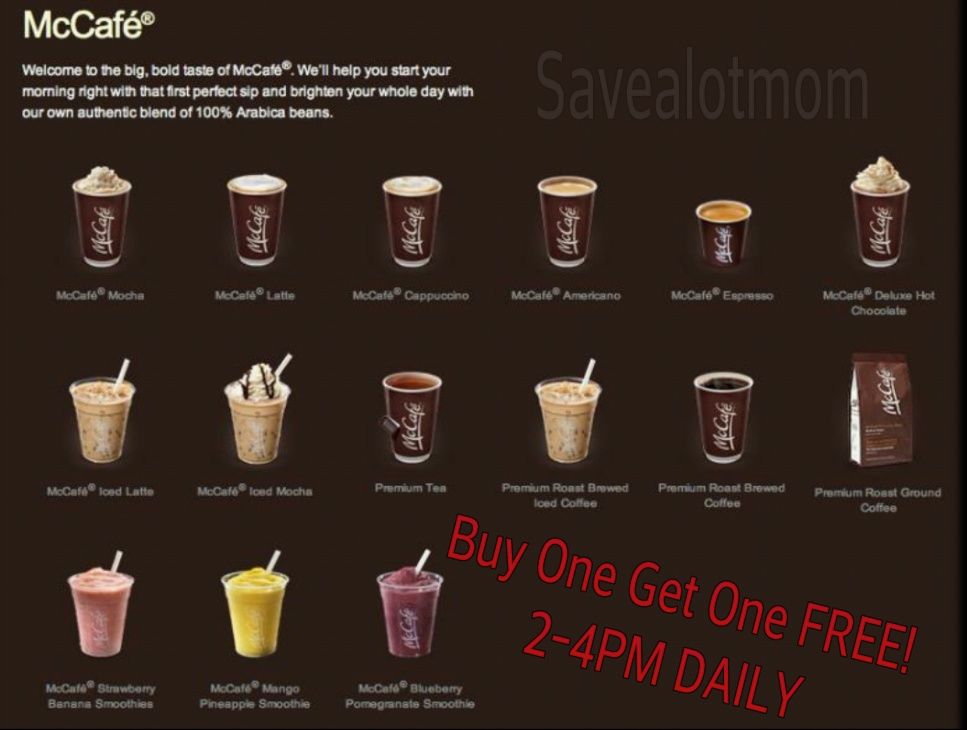
At participating Killeen, Cove, Heights and surrounding locations, McDonald's is offering Buy One Get One FREE ANY McCafe drinks and any size between 2-4pm every day!
No Coupons Needed. Just ask to ensure that your McDonald's is offering it before you order it! Times and offer may vary by location.
Jennise "Savealotmom" Colin-Ventura | 254-501-7515 | jennise@kdhnews.com | facebook.com/savealotmom | instagram @jensavealotmom
Savealotmom
Get email notifications on Savealotmom daily!
Whenever Savealotmom posts new content, you'll get an email delivered to your inbox with a link.
Email notifications are only sent once a day, and only if there are new matching items.
Followed notifications
Please log in to use this feature
Post a comment as
Watch this discussion. Stop watching this discussion.
(0) comments
Welcome to the discussion.
Keep it Clean. Please avoid obscene, vulgar, lewd, racist or sexually-oriented language.
PLEASE TURN OFF YOUR CAPS LOCK.
Don't Threaten. Threats of harming another person will not be tolerated.
Be Truthful. Don't knowingly lie about anyone or anything.
Be Nice. No racism, sexism or any sort of -ism that is degrading to another person.
Be Proactive. Use the 'Report' link on each comment to let us know of abusive posts.
Share with Us. We'd love to hear eyewitness accounts, the history behind an article.
Today's e-Edition
Killeen Daily News
Do you think Killeen will be able to attract another airline to its regional airport after Delta pulls out in January?
Most Popular
Images
- Two chances Monday to meet Killeen's new police chief (18)
- KISD claims progress since special education audit (16)
- Details on possible Killeen bond few and far between (14)
- Reader calls for discussion about moving Civil War monuments (14)
- KISD tax rates would increase with bond (10)
- KISD bond potential costs top $700 million (9)
- KISD panel recommends $426 million bond (8)
- KISD bond steering committee to meet at East Ward (8)
- Killeen police chief: ‘We’re trying to suppress crime’ (8)
- Killeen could float millions in debt as companion to KISD bond (8)
Follow us on Facebook
Follow us on Twitter
Lampasas Tour of Homes is today
- Dec 3, 2017
The Lampasas County Museum is hosting a Tour of Homes today from 1 to 5 p.m. to raise funds for the museum’s programs.
KISD student athlete symposium is today
- Dec 2, 2017
Killeen Independent School District athletes and their parents are invited to a symposium from 6 to 8 p.m. today at Roy J. Smith Middle School in Killeen.
Central Texas special needs fair is Friday
- Nov 29, 2017
From 9 a.m. to 7 p.m. Friday, the Killeen Independent School District and Texas A&M University-Central Texas will host a special education transition fair at the A&M-Central Texas campus in Warrior Hall.
Local group is looking for volunteers
- Nov 29, 2017
Teen Leaders in Community Involvement is an organization that is searching for new volunteers and way to help the Killeen community. The organization will be volunteering in community events with a goal of setting good examples through involvement and good citizenship. Age limit is 14-17. Fo…
fastfoodgermany
4 пользователя находятся здесь
МОДЕРАТОРЫ


Welcome to Reddit,
the front page of the internet.
and subscribe to one of thousands of communities.

отправлено 25 дней назад автор r32r32r
Want to add to the discussion?
Похоже, здесь ничего нет.
- помощь
- правила сайта
- центр поддержки
- вики
- реддикет
- mod guidelines
- связаться с нами
- приложенияи инструменты
- Reddit for iPhone
- Reddit for Android
- mobile website
- кнопки
Использование данного сайта означает, что вы принимаете пользовательского соглашения и Политика конфиденциальности. © 2017 reddit инкорпорейтед. Все права защищены.
REDDIT and the ALIEN Logo are registered trademarks of reddit inc.

π Rendered by PID 128639 on app-18 at 2017-12-05 07:38:54.928622+00:00 running 1ad2cd5 country code: RU.
The New York Times

August 8, 2016
President Obama is so disciplined that his wife has teased that he eats precisely seven lightly salted almonds each night.
George W. Bush was an exercise buff, obsessed with staying trim by mountain biking and clearing brush at his ranch in Crawford, Tex.
But Donald J. Trump is taking a different approach: A junk food aficionado, he is hoping to become the nation’s fast food president.
“A ‘fish delight,’ sometimes, right?” Mr. Trump told Anderson Cooper at a CNN town-hall-style meeting in February, extolling the virtues of McDonald’s. “The Big Macs are great. The Quarter Pounder. It’s great stuff.”
Mr. Trump’s presidential campaign is improvised, undisciplined, rushed and self-indulgent.
And so is his diet.
In an era of gourmet dining and obsession with healthy ingredients, Mr. Trump is a throwback to an earlier, more carefree time in American eating, when nobody bothered to ask whether the tomatoes were locally grown, and the first lady certainly didn’t have a vegetable garden, complete with a bee hive, on the South Lawn of the White House.
But in Facebook, Instagram and Twitter posts, Mr. Trump has broadcast his culinary preferences to the nation — devouring a bucket of Kentucky Fried Chicken (while reading The Wall Street Journal), feasting on a McDonald’s burger and fries (to celebrate clinching the Republican presidential nomination) and chowing down on a taco bowl (in an effort to woo Hispanic voters).
Great afternoon in Ohio & a great evening in Pennsylvania - departing now. See you tomorrow Virginia! pic.twitter.com/jQTQYBFpdb
He is a lover of diner fare and fast food grub, of overcooked steaks (“It would rock on the plate, it was so well done,” his longtime butler once observed) and the bland nourishment of Americana. He prefers burgers and meatloaf, Caesar salads and spaghetti, See’s Candies and Diet Coke. And he shuns tea, coffee and alcohol.
But his highbrow, lowbrow image — of the jet-setting mogul who takes buckets of fried chicken onto his private plane with the gold-plated seatbelt buckles — is also a carefully crafted one.
If President George Bush revealed his patrician upbringing by requesting “a splash” more coffee at a truck stop in New Hampshire, and John Kerry helped reinforce his image as a New England blue blood by trying to order a cheese steak with Swiss in South Philadelphia, Mr. Trump’s diet also telegraphs to his blue-collar base that he is one of them.
“There’s nothing more American and more of-the-people than fast food,” said Russ Schriefer, a Republican strategist and ad maker. “It is the peculiarity of the brand that he’s able to be on his multimillion-dollar jet with the gold and black branding and colors, and at the same time eat KFC — and what makes it perfect is he does it all with a knife and fork, while reading The Wall Street Journal.”
Or, as Kellyanne Conway, a senior adviser and pollster on the Trump campaign, put it, “It goes with his authenticity.”
“I don’t think Hillary Clinton would be eating Popeye’s biscuits and fried chicken,” she said.
Last April, Mrs. Clinton did, indeed, visit a Chipotle near Toledo, Ohio, stopping into the chain restaurant unrecognized, in black sunglasses, and ordering a chicken burrito bowl.
Interactive Feature | 2016 Election Polls
And President Bill Clinton was perhaps the nation’s first fast food commander in chief, famous for ending his jogs at McDonald’s. (Mr. Clinton now adheres to a largely vegan diet.)
Still, Mr. Trump seems to come by his appetite for fast food genuinely.
While junk food has long been a staple of campaign trail life — Mitt Romney’s 2012 press corps coined the term “slunch” to refer to the unhealthy phenomenon of the “second lunch” — Mr. Trump’s reliance on high-calorie fare is driven more by a combination of speed, efficiency and, above all else, cleanliness.
Though he often orders from the Trump Grill when working out of Trump Tower in Manhattan, he eats fast food several times a week while on the road because “it’s quick,” as he told The Daily Mail last year while munching on Burger King on his Boeing 757-200.
Mr. Trump has even suggested doing away with state dinners, in a fit of cost and time savings. “We should be eating a hamburger on a conference table, and we should make better deals with China and others and forget the state dinners,” he said.
A man always prone to distraction and uninterested in small details, he has never approached food as anything other than a problem to be solved, quickly, as Gov. Chris Christie of New Jersey, an occasional dining partner, once told The Washington Examiner.
As the two men ate at Jean-Georges in Manhattan in 2002, Mr. Trump ordered briskly and imperiously from the head chef and owner, Mr. Christie recalled. “Jean-Georges, remember the appetizer you made for me last week when I was here?” Mr. Trump asked the owner. “We’ll take two of those. And remember that main course you made, the special thing you made for me? We’ll take two of those, too.”
Mr. Christie watched with confusion and a bit of awe, he recalled in the interview. Mr. Trump looked at him and said, “Don’t worry, you’ll love it.”
But Mr. Trump, who frets about germs and prizes cleanliness, also loves fast food because of its consistency and the promise, at least, of a basic level of hygiene.
“One bad hamburger, you can destroy McDonald’s. One bad hamburger, you take Wendy’s and all these other places and they’re out of business,” Mr. Trump told Mr. Cooper of CNN. “I’m a very clean person. I like cleanliness, and I think you’re better off going there than maybe someplace that you have no idea where the food’s coming from. It’s a certain standard.”
Still, he added, “I think the food’s good.”
Mr. Trump’s dining habits also bespeak a certain lack of creativity, and parochialism — the kid from Queens who made it across the river to Manhattan’s glistening skyline, but never cottoned to the city’s haute cuisine. He once praised the “imagination” of his wife, Melania, in the kitchen — before citing, as examples of her culinary derring-do, spaghetti and meat sauce, salads and meatloaf. (He still keeps a copy of his mother’s meatloaf recipe.) Along with McDonald’s, his favorite fast food joint, a family member said, is Jackson Hole Burgers.
Interactive Feature | Sign Up for the First Draft Newsletter Subscribe for updates on the White House and Congress, delivered to your inbox Monday through Friday.
He is also a stickler for manners, attacking his primary race rival, Gov. John Kasich of Ohio, for scarfing down meals during impromptu news conferences. “I’ve never seen a human being eat in such a disgusting fashion!” Mr. Trump told a crowd.
And Mr. Trump, who sometimes sips his Diet Coke through a straw, once caused Manhattan foodies to weep into their quinoa when he took Sarah Palin to a Famous Famiglia pizza restaurant in Times Square — and then proceeded to cut his oversize slice with a plastic knife and fork.
He has other pretensions, as well. Howie Carr, a Boston Herald columnist, recalled traveling on Mr. Trump’s plane and watching him rip the buns off his McDonald’s patties before plying the burgers with ketchup. (“Do you know how many calories you save that way?” Mr. Trump asked Mr. Carr.) And Mr. Trump also told US Weekly that he tries to save calories on pizza. (“I scrape the toppings off my pizza — I never eat the dough,” he said.)
So pronounced are Mr. Trump’s fast food preferences that Philip E. Beshara, a Washington-based lawyer, joked on Instagram that, as president, his cabinet would probably be staffed by Colonel Sanders, the Hamburglar and the Taco Bell Chihuahua.
And, of course, the Republican nominee’s dining whims also keep his team on its toes, with staff members worrying not just about the backdrop for his speeches — but also where to find the nearest drive-through.
“There’s never any real planning for food,” said one, between events on Friday. “It’s always just whatever he is craving, which is more often than not McDonald’s.”
Nick Corasaniti and Kitty Bennett contributed reporting.
Find out what you need to know about the 2016 presidential race today, and get politics news updates via Facebook, Twitter and the First Draft newsletter.
Related Coverage
More In Presidential Election 2016 Complete coverage of the 2016 presidential race and Donald J. Trump’s victory.
More In PoliticsMore In U.S. Politics
- Roy Moore Gets Trump Endorsement and R.N.C. Funding for Senate Race
The Republican National Committee restored its support for Mr. Moore, the Senate candidate in Alabama who has stabilized in the polls after sexual misconduct accusations.
The decision was a victory for the administration after its mixed success before the court over the summer, when justices considered and later dismissed disputes over the second version.
What About Acrylamide In Coffee?
In response to my post on saying yes or no to coffee, a reader named Jillian shared the following concern:
"As a coffee drinker, I would like any reason to blindly drink it without any concern, but one thing not addressed in your article is roasting. I have heard about carcinogenic effects of roasting/charring/grilling etc. Doesn't Starbucks have to put up warning signs in California because of their roasting process?"
Jillian brings up a valid point. Acrylamide is a possible carcinogen that is found in starchy foods that have been fried or baked at high temperatures. And yes, testing by federal agencies in multiple countries have confirmed that most types of coffee contain acrylamide.
Thus far, all published studies on acrylamide that I have reviewed have established links between acrylamide exposure and increased risk of cancer. But no one knows how much acrylamide intake is needed to "tip the scales." Put another way, how much acrylamide do you need to have in your body before you are certain to have health problems? And do factors like how antioxidant-rich your diet is, how much rest you get, how much fresh air you are exposed to, and how emotionally balanced you are affect how much acrylamide your body can handle?
One thing is for sure: all of us are exposed to some acrylamide as we go about our daily lives. Acrylamide is widely used to manufacture a variety of polymers, which are used as thickening and binding agents in sugar manufacturing, plastic products (including food packaging products), cosmetics, grout, cement, sewage and wastewater treatment, and even in some types of potting soil. Acrylamide is also heavily used in molecular biology labs, mainly as polyacrylamide when carrying out gel electrophoresis.
So in stepping back to look at the big picture, how much acrylamide are we getting from one or two cups of coffee daily?
Here is some data on acrylamide content of common foods (on an as-consumed basis, in micrograms of acrylamide in each kilogram of food), produced by the Canadian government in 2012:
Heinz prune baby food: 108
Gerber sweet potatoes baby food: 79
Tim Horton's plain donut: 23
Honey Nut Cheerios cereal: 79
Corn Flakes cereal: 58
Rice Crispies cereal: 58
Special K cereal: 229
Hershey creamy milk chocolate: 37
Sesame snaps: 96
Kraft Arrowroot cookies: 207
Honey Maid graham wafers: 261
Purity Ginger Snaps: 578
Oreo cookies: 23
Ritz crackers: 408
Dempster's multigrain bread (not toasted): 46
Dempster's multigrain bread (lightly toasted): 68
Dempster's multigrain bread (medium toasting): 92
Dempster's muligrain bread (dark toasting): 145
Raisin cinnamon bread: Dr. Ben Kim
Thought of the Moment
New Natural Health Resources

Most Popular Natural Health Tools

Recent comments
Receive Updates Plus Occasional Shockers
 Dr. Ben Kim's Newsletter
Your e-mail address is kept private and you can unsubscribe anytime.
More Natural Health Resources
Professional Grade Nutritional Supplements
Professional Grade Probiotic and Enzyme Blends
Professional Grade Target Formulas
Raw Organic Superfood Powders
Natural Personal Care Products
Raw Organic Protein Powders
Premium Coconut Products
Organically Grown Whole Foods
Natural Health Tools
Carlson Products
Holistic Audio Programs
Books & Special Reports
Fundamentals of Getting Healthy Naturally
The contents of this website are the opinions of Dr. Ben Kim unless otherwise noted. The information on this website is not intended as personalized medical advice and is not intended to replace the relationship that you have with your primary care provider. Any decisions you make with regard to your daily choices and medical treatments should be made with the help of a qualified health care provider.
Bacon & Egg McMuffin ®
A hot brekkie made compact. A perfectly cooked egg, deli style bacon and a slice of cheese, cased in a toasted, warm English muffin.
Available until 10:30am at participating restaurants unless part of All Day Breakfast Menu.
Please be aware that there is always a risk that traces of allergens may be transferred to items on our menu during processing, storage or preparation in our kitchens. McDonald's is therefore unable to guarantee that any item sold is free from traces of allergens.
ENGLISH MUFFIN : Wheat Flour, Water, Yeast, Ground Maize (Preservative 200), Gluten , Sugar, Iodised Salt, Canola Oil, Preservative (282), Dough Improver [( Soy Flour, Emulsifier 481, Mineral Salt (170, 516), Malt Flour, Dough Conditioner 300, Enzymes (amylase, xylanase)], Emulsifiers (471, 472e), Antioxidants (304, 307, 330), Food Acids (341, 297, 262), Enzyme (1101), Vitamins (Thiamine, Folate).
BACON: Pork, Water, Salt, Sugar, Emulsifiers (451, 450), Dextrose (Maize, Tapioca), Antioxidant (316), Acidity Regulator(330), Sodium Nitrite (250), Rosemary Extract. Smoked.
CHEESE: Cheese (Milk, Salt, Culture, Enzymes (Rennet, Lipase)), Water, Milk Solids, Butter, Emulsifiers (340, 452, 331), Salt, Acidity Regulators (260, 330, 339), Colours (160b, 160c), Preservative (200), Soy Lecithin.
OIL: Canola Oil, Emulsifiers (Soy Lecithin), Flavour, Colour (160a), Acidity Regulator (330) .
Contains gluten, egg, milk & soy.
ENGLISH MUFFINS are produced on equipment that also produces products containing sesame seeds.
McDonald's Speisekarte und Zutaten
McDonald's Deutschland
McDonald's Speisekarte und Zutaten Lyrics
Speisekarte
Burger & McNuggets
Hamburger Royal Käse
Hamburger Royal TS®
6er Chicken McNuggets®
9er Chicken McNuggets®
Doppel Royal Cheese
4er Chicken McNuggets®
20er Chicken McNuggets®
McWrap® Thai Curry Chicken
McWrap® Tomate Mozzarella mit Chicken
Pommes Frites (klein/mittel/groß)
Saucen & Dressings
Snack Salat Classic
Snack Salat Chef
Snack Salat Tomate Mozzarella
McSundae® mit Schokosauce
McSundae® mit Karamellsauce
McMuffin® Chicken & Bacon
McMuffin® Bacon & Egg
McMuffin® Sausage & Egg
McMuffin® Sausage TS
McMuffin® Fresh Chicken
Iced Fruit Smoothies & Frappés
Iced Fruit Smoothie Mango Ananas
Iced Fruit Smoothie Erdbeer Banane
Iced Frappé Coffee Choc
Iced Frappé Coffee Caramel
Modifizierte Maisstärke (E1412, E1442)
Mono- und Diglyceride von Speisefettsäuren (E471)
Food & Drink
The truth about decaf coffee

Published August 25, 2014

Green coffee beans before (L) and after (R) the decaffeination process. (2014 Alastair Bird, SWISS WATER®)

An operators dumping the beans into the decaffeination process machine. (SWISS WATER® )

A cup of coffee surrounded by roasted beans. (iStock)
Millions of Americans drink decaf coffee to get that perfectly bitter taste without all the jitters.
But does decaf really have no caffeine? What’s the difference between "decaffeinated" and "naturally decaffeinated”? And are the chemicals used to strip the caffeine from coffee safe?
To understand what’s in your cup of decaf, you first need to understand what’s not in it.
FDA regulations specify that for coffee to bear a decaffeinated label, 97 percent of the original caffeine must be removed from the beans. So, yes, there’s caffeine in decaf coffee. But it’s not very much, right?
Not so fast. Caffeine content varies from bean to bean.
Coffee in America generally contains one or a blend of two bean types – the hardy Robusta bean and the sweeter, delicate Arabica bean. Robusta beans generally contain twice the caffeine of Arabica beans, but their harsh taste is often considered inferior. Instant coffee brands like Folgers and Maxwell House tend to be Robusta blends, while coffee houses like Caribou and Starbucks pride themselves on their pure Arabica beans.
While 97 percent of the caffeine must be removed, the Robusta bean will have more caffeine left over than the Arabica bean after the decaffeination process is completed, which can lead to a lot of variance among brands.
The FDA does not require the amount of caffeine to be labeled on decaffeinated coffee products, but the upshot is that if you’re looking for less caffeine in your cup, you should pay attention to the type of bean that goes into it.
The average 12-ounce cup of decaf coffee – a Starbucks tall – usually contains between 3 and 18 milligrams of caffeine. (By comparison, an 8.4-ounce can of Red Bull contains 80 milligrams of caffeine) The average of amount of caffeine in regular coffee can vary significantly, usually between 140 and 300 mg.
In 2007, Consumer Reports studied cups of decaffeinated coffee from popular chains. While most cups had fewer than 5 milligrams of caffeine, one cup from Dunkin Donuts contained a whopping 32 milligrams, and another from Seattle’s Best came in at 29 milligrams – certainly not a caffeine-free choice . In their sample, decaf cups from McDonald’s consistently had the fewest milligrams of caffeine.
Maria Bella, a nutritionist who founded Top Balance Nutrition, a weight management and healthful eating consulting center, in New York City, says caffeine sensitivity will affect how jittery you feel, and it may be influenced by other factors like diet and daily schedule.
She stresses that there is no such thing as coffee with zero caffeine in it.
“Beverages should only be considered ‘caffeine-free’ if there was never any caffeine in the ingredients to begin with,” she says. “Coffee and non-herbal teas should not be labeled caffeine-free.”
So how do you get (almost) all that caffeine out of the coffee, anyway?
The caffeine is removed from green coffee beans, before they are roasted, and there are a number of different processes, all of which affect the roasting process and how long the coffee stays fresh. (Decaf coffee goes stale almost twice as fast as regular coffee.)
The first decaffeination method, developed in the early 1900s, used a repetitive rinsing process aided by the chemical benzene, which is no longer used because it is a known cancer-causing agent.
Today, like seasoned vintners, coffee processors favor different decaffeination methods for optimum taste and quality.
Many brands use the Direct Process, which involves the chemical methyl chloride.
Two other methods are the Natural Process, which removes the caffeine using the plant hormone ethyl acetate or carbon dioxide, and the Water Process, which uses no chemical agents, just pure H2O.
Processes utilizing CO2 and the Water Process, pioneered by SWISS WATER®, are both considered Natural Processes and are the only methods that can be certified organic. And while organic coffee is gaining popularity, it is still hard to find in many supermarkets.
Methyl chloride, used in the Direct Process, is listed as a possible carcinogen by the National Cancer Institute, but FDA regulations consider up to 10 parts per million (ppm) to be safe for consumption. Trace amounts of the chemical have been found in decaf coffee brews, but most blends have a concentration at or below 1 ppm.
Lorenzo Perkins of Cuvee Coffee in Austin, Texas, who has been brewing coffee for 13 years, says that small trace is not a cause for concern. As a SCAA—Specialty Coffee Association of American-- certified level 2 barista and vice chair of the Barista Guild of America, he’s seen it all when it comes to coffee production.
“Methyl chloride has the least affect on taste because of the way the chemical bonds with the alkaloids in caffeine,” Perkins said. “It leaves the other organic material alone, resulting in a superior tasting coffee.”
Nonetheless, coffee producers are increasingly sensitive to consumer concerns about additives. Starbucks, which uses methyl chloride to decaffeinate most of its blends, now offers a “naturally processed” decaf Sumatra brew. Caribou Coffee uses a non-chemical water process in all its decaf blends. And the Coffee Bean says it tests its decaffeinated blends to ensure that there are no chemical residues from the process it uses.
One final note about decaf: Studies have linked excessive regular coffee drinking to hypertension, decreased bone density and high levels of gastric acidity. And while switching to decaf might help with insomnia, those looking to avoid other unwanted health problems associated with coffee should not assume that eliminating their caffeine intake is the answer.
“Many health conditions that are affected by coffee are also aggravated by drinking decaf, due to the phytochemicals that remain after the decaffeination process,” Bella said.
These conditions include increased gastric acidity (heartburn or GERD), interfering with mineral absorption (particularly iron) and increased incidence of rheumatoid arthritis.
Bella says that up to 400 milligrams of caffeine is considered fine for most adults in good health.
Trending in Food & Drink
RNC to support Roy Moore in Senate race after cutting fundraising ties weeks ago
Hatch defends Moore endorsement, says alleged sexual misconduct happened 'decades ago'
Trump campaign drama: Book reveals Manafort clashes, Trump superstitions, epic tirades
Mitt Romney, Roy Moore get into Twitter spat over sexual misconduct allegations
Massachusetts Senate president steps aside amid sexual misconduct probe against his husband
Tools
Follow
This material may not be published, broadcast, rewritten, or redistributed. ©2017 FOX News Network, LLC. All rights reserved. All market data delayed 20 minutes.
Patchwork & Pastry
My intercultural, interracial suburban life in small town U.S.A

Tagged with Kaffee
Cafe Frappe
Fancy coffee drinks have become “the thing” in the last few years. I see people buying/drinking/walking around with all sorts of so-called “fancy”, so-called “coffee” drinks, full of artificial ingredients of all sorts, laden down with sugar and lacking the one thing in their name: coffee. (can you tell I am not a fan?)
Eine neue Art von Kaffee Getränken sind in letzter Zeit sehr beliebt. Ich sehe viele Leute mit diesen so gemeinten “neuen”, so gemeinten “Kaffee” Getränken herumlaufen. Sie sind voll von Chemie, voll mit Zucker/Süssstoff, und haben sehr wenig mit einem zu tun: Kaffee.
I love coffee; I drink coffee all day long, every day. During a visit to a Greek Food Truck in Durham a few weeks ago, I was reminded of a coffee drink that I love: Cafe Frappe. It is VERY similar to those fancy, expensive drinks, but tastes much better (my opinion), is easy to make and requires only three ingredients (four if you add whipped cream).
Ich liebe Kaffee – Ich drink Kaffee jeden Tag, den ganzen Tag lang. Vor ein paar Wochen war ich beim Griechen Mittag essen, und dort gab’s ein Getränk aus meiner griechischen Heimat: Cafe Frappe. Es ist diesen teuren Getränken sehr ähnlich, schmeckt aber sehr viel besser (mein Meinung), ist sehr leicht zu machen, und hat nur drei Zutaten (vier mit Schlag Sahne).
Ice Cubes & Water
Coffe Creamer or Milk or Cream
Whipped Cream (optional)
Special Equipment: a manual shaker or a milk frother or an immersion blender
1 Teelöffel löslicher Kaffee
3/4 Teelöffel Zucker
Kaffeesahne oder Milch
Milchschäumer oder ein Mixbecher oder ein Schüttelbecher – optional

1. Place Instant Coffee and Sugar into a tall glass (or into your shaker if that is what you are using). Add just enough water to cover the coffee/sugar.
1. Kaffee und Zucker in ein grosses Glass geben (oder in den Schüttelbecher). Ein ganz wenig Wasser darüber schütten (ca. 1 oder 2 cm).

2. Using the milk frother (immersion blender) whip the mixture until it changes to a light brown color, triple in size and becomes a creamy foam – it will resemble Cool Whip in consistency.
2. Mit dem Milchschäummer verrühren bis die Mischung hellbraun ist, das Glass halbvoll ist und sie wie Schlagsahne aussieht.

3. Add Ice Cubes, then water to fill the glass. If you stop here, you will have a VERY strong, intensely coffee flavored drink. I like to add coffee creamer to mine, approximately two teaspoons, which makes it taste more like an Iced Coffee Drink.
3. Jetzt Eiswürfel und Wasser hinzufügen bis das Glass voll ist. Dieses Getränk ist sehr stark und schmeckt sehr intensiv nach Kaffee. Ich gebe Kaffeesahne in mein Getränk, ca. zwei Teelöffel.

And here is the best part: Buying the coffee drinks at Mcdonald’s, Starbucks or anywhere else, relieves your wallet of anywhere from $3.00 – $7.00 and adds 450-1200 Calories to your diet!
Und hier ist das Beste: Kaffee Getränke bei McDonald’s oder Starbucks oder wo-auch-immer kosten $3.00 – $7.00 und haben 450-1200 Kalorien.
This drink costs almost nothing (25 cents for a teaspoon of instant coffee and approximately 16 cents for the coffee creamer). I paid $8.00 for the battery operated milk frother. It has less than 100 calories – no matter what size I make it.
“Mein” Getränk kostet fast gar nichts (ca. 25 cents für den Kaffee und ca. 16 cents für die Kaffeesahne), Ich habe $8.00 für den Milchschäumen bezahlt. Es hat weniger als 100 Kalorien, egal ob man ein grosses oder kleines Glass trinkt.
My niece B., makes a FABULOUS hot version of this drink – I have no idea how she does it! Maybe one day she’ll send me the recipe!
Meine Nichte B., macht eine ganz, ganz tolle heisse version von diesem Getränk – ich habe keine Ahnung wie; ich hoffe sie wird mir irgendwann das Rezept verraten!


Комментариев нет:
Отправить комментарий